Powering EVs: The in's and out's of fleet charging infrastructure
April 1, 2026What sort of public and private charging options are best for your fleet?

As of the end of 2025, there are about 7 million EVs on the road in the United States, and fleets continue to adopt them for cost-savings and other benefits. One of the biggest concerns of fleet electrification is worry over how far a vehicle can travel on a single charge, what's referred to as "range anxiety." If you’re thinking about adding EVs to your fleet, you’ll first need to understand the availability of public charging facilities and the cost and effort involved with installing your own infrastructure.
Searching for a charge: How many public charging stations are out there?
As of early 2026, there are roughly 77,000 public EV charging stations housing more than 326,000 charging ports across the country, with about a quarter of all stations still concentrated in California. With millions of EVs now on American roads, it's not hard to see why charging access remains a concern. An AP-NORC/EPIC poll from late 2025 found that about 4 in 10 U.S. adults still point to range and charging time as "major" reasons they wouldn't buy an EV.
The good news is the infrastructure is growing fast. Paren's 2025 industry report found that deployment of new DC fast-charging ports increased 30% year over year, with the national total passing 70,000 fast-charging ports by year's end. The report forecasts nearly 20,000 additional fast-charging ports in 2026 alone, pushing the total toward 90,000. And the AP analysis noted above found that nearly 70% of the combined length of the 10 longest U.S. interstates is now within 10 miles of a fast charger, which is up from about half just five years ago.
Much of this growth is being driven by the private sector. Convenience store and fuel retail chains are rapidly adding EV charging alongside their gas pumps. Wawa has partnered with IONNA - a charging network backed by eight major automakers including GM, BMW, Toyota, and Hyundai — to deploy high-speed "Rechargery" charging stations across its 1,100+ locations. Sheetz, Love's Travel Stops, Pilot Flying J, Buc-ee's, and 7-Eleven (which launched its own proprietary 7Charge network) are all building out charging infrastructure as well. As Grist reported in November 2025, the competitive question among fuel retailers is shifting from who offers the cheapest gas to who makes the 20 minutes spent charging the best customer experience — with clean restrooms, made-to-order food, and wi-fi lounges becoming key differentiators.
While not every city has robust public charging in place yet, finding a station has never been easier. Apps like PlugShare, ChargePoint, and EVgo allow drivers to search for nearby stations, filter by charger type and speed, check real-time availability, estimate charge costs, and even start and pay for sessions directly. Google Maps and Apple Maps both now integrate EV charging station data, including real-time availability on many networks. Tesla's Supercharger network — the country's largest, with over 35,000 ports — has opened more than two-thirds of its stations to non-Tesla EVs, dramatically expanding access for all drivers.
While apps and expanding public networks are eliminating much of the hassle of EV charging, the most reliable way to charge a fleet is still at your own headquarters.
Setting up charging stations for electric cars at your headquarters
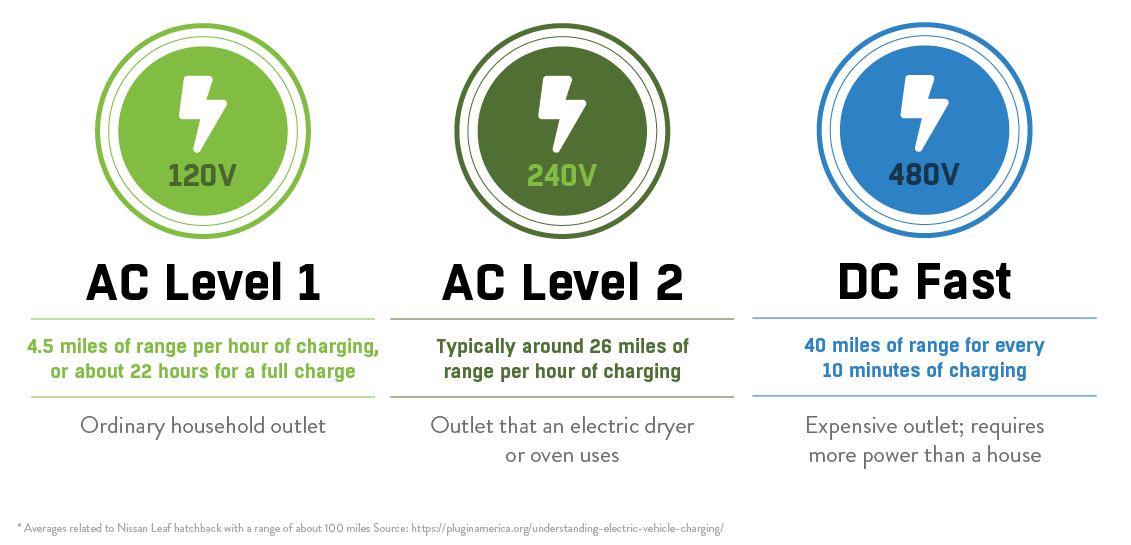
The easiest and most cost-effective way to charge fleet EVs is with a reliable charging setup at your place of business. There are two charger types that matter for fleets: Level 2 AC chargers and DC fast chargers (DCFC). Level 2 chargers deliver 7 to 19 kW of power, adding roughly 20 to 40 miles of range per hour — making them ideal for overnight depot charging, where vehicles sit for 8 to 12 hours between shifts. DC fast chargers bypass the vehicle's onboard charger entirely and deliver power directly to the battery at 50 to 350 kW, charging to 80% in as little as 20 minutes. Level 1 chargers (standard 120V outlets) are far too slow for most every fleet application.
Fleet managers need to evaluate how many chargers they need, what type, and how to phase them in over time.
Before setting up chargers on your fleet site, there are a few things to keep in mind:
- Engage your utility company early. This may be the single most important step. Electrical service upgrades — new transformers, additional feeders, panel upgrades — can take 12 to 18 months and cost $50,000 to $500,000+ depending on scope. Many utilities offer EV-specific rate structures, demand charge relief programs, and "make-ready" incentives that cover part of the infrastructure cost. Start this conversation well before you plan to install chargers.
- Assess your site's electrical capacity. Have a licensed electrician audit your depot's existing service. A standard 200-amp panel at 208V provides roughly 41 kW — enough for two to five Level 2 chargers, but not enough for even a single DCFC. Ten Level 2 chargers at 19 kW each need 190 kW of capacity. Know what you have, what you're consuming, and what's available before you order equipment.
- Match charger type to vehicle dwell time. For fleets that return to the depot overnight — last-mile delivery vans, municipal vehicles, school buses — Level 2 is typically the right fit. It's lower cost, gentler on batteries over time, and the most cost-effective per kWh delivered. For multi-shift operations or vehicles that need rapid turnaround between routes, DCFC provides the speed — but at significantly higher hardware, installation, and electricity costs. Many fleets find that a Level 2 base with strategic DCFC for operational flexibility works best.
- Plan charger placement around your operations. Position chargers wherever you normally park your EVs so they can be accessed regularly and easily. Proximity to your electrical panel directly affects installation cost, since shorter cable runs mean lower expense. Also consider vehicle turning radius, cable management, ADA compliance, protection from vehicle impact, and drainage and snow removal.
- Invest in smart charger software. Charging management software allows you to schedule charging during off-peak hours (when electricity rates are lowest), balance loads across multiple vehicles so you don't spike demand charges, and monitor charger status remotely. Fleets using managed charging report up to 40% reduction in electricity costs. Look for systems that comply with OCPP (Open Charge Point Protocol) so you're not locked into a single vendor.
- Build for future scale. Even if you're starting with a small pilot, add extra circuits, electrical capacity, and conduit from the panel now. According to the DOE's Alternative Fuels Data Center, it's significantly less expensive to build in extra capacity upfront than to retrofit later. A modular approach — start small, prove the concept, then expand — is the recommended path for most fleets.
What factors can we watch for that will help us predict charging station expansion?
With so much to consider, the timeline for fleet electrification depends heavily on where you operate. The policy landscape has shifted significantly: federal EV purchase tax credits expired on September 30, 2025, and the EV charger infrastructure credit (30C) is set to expire June 30, 2026. But state and local initiatives continue to push the market forward — and in many cases, are accelerating.
As of 2025, 33 states have set policies to transition their government-owned fleets to zero-emission vehicles through legislative mandates or executive orders. A few notable examples:
California requires that 50% of all non-public-safety, light-duty state fleet acquisitions be zero emission vehicles (ZEVs), and is streamlining approvals for zero-emission transit infrastructure under SB71.
**New York City**remains a national leader in municipal fleet electrification. In 2025, the city deployed its first all-electric FDNY paramedic response units through 911 calls and announced that all Taxi and Limousine Commission vehicles must be zero-emission.
Connecticut passed legislation requiring its state fleet to be 50% electric by 2026, 75% by 2028, and fully electric by 2030 — though it has acknowledged the 2026 target will be difficult to meet, citing charging infrastructure and vehicle supply constraints.
**Illinois**requires that state fleet light-duty vehicles achieve 100% zero-emission purchases by 2030.
Washington, D.C. has set a goal for 100% ZEV procurement starting in 2026.
Beyond mandates, the economics are increasingly doing the persuading on their own. Fleet electrification decisions are now being driven less by sustainability commitments and more by total cost of ownership (TCO) calculators that account for fuel savings, maintenance reductions, and long-term value, not just sticker price. Multiple states, including California and Delaware, now require TCO analysis in government fleet procurement decisions. For private fleets, the math is trending in the same direction: battery costs continue to fall, more electric van and truck models are entering the market, and depot charging solutions have become standardized and more affordable.
The bottom line for fleet managers: even without federal incentives, the combination of state programs, utility make-ready rebates, falling vehicle costs, and operational savings is making the case for electrification stronger with each passing year. Fleets that begin strategic planning now will be best positioned to capture cost advantages as the economics increasingly favor EVs regardless of incentive availability.
What’s next for the future of EV charging stations?
Once you make the shift to EVs, the benefits compound quickly. As we've outlined throughout this article, fleet EVs cost significantly less per mile to fuel and maintain, and with battery prices continuing to fall and vehicle options expanding across every class, the total cost of ownership case gets stronger each year, with or without federal incentives. You'll also be aligning with the growing expectations of customers, employees, and partners who increasingly view sustainability as a baseline, not a differentiator.
The charging landscape has transformed. With more than 326,000 public charging ports nationwide, a unified NACS connector standard, and major retailers racing to make their locations the best place to spend 20 minutes, long-distance route planning for fleet EVs is no longer the obstacle it once was. And with forecasts projecting nearly 90,000 DC fast-charging ports by the end of 2026 — and continued investment from automaker-backed networks, convenience chains, and private operators — that infrastructure will only become more robust.
Are you planning to charge forward with electrifying your fleet? Reach out to Mike Albert to learn more about the benefits of EVs and how we can help ensure the transition is a smooth one here.
Skills covered in the class
Mobility-Mindset
Fleet Electrification
Data-Driven Decision Making
Operational Efficiency
Did you enjoy this class?
Share it with your organization and colleagues.