
2027 fleet outlook: What our experts see out ahead
October 27, 2026We asked two of our fleet experts to share the challenges and opportunities our industry will face in 2027.
What you'll learn in this article
- After a few years of waiting out uncertainty, fleets have run out of reasons to delay vehicle replacement.
- Vehicle prices, fuel, insurance, and maintenance will keep squeezing budgets, pushing fleets to rethink aspects of their operations to find new ways to save.
- Cycling plans are back, and the strongest fleets now build several a year, with back-up plans. Every vehicle choice needs a plan B and a plan C.
- Payload limits on midsize pickups and a consolidating truck cap market are giving full-size vans a second look.
- Each industry vertical has its own fleet challenges and opportunities.
- AI has a lot to offer fleets, but a council of human advisors offers even more.
"At some point, we just have to get over the uncertainty."
That's how Alexa Rubin, Truck Upfit Manager at Mike Albert, sums up the mood among the fleet managers and upfit pros she talks with every week. Wars, tariffs, supply chain surprises. Fleets have absorbed a lot, and many, understandably, played it safe the whole way.
"But now that the industry is two or three years into this uncertainty, people are tired of waiting and ready to move on," Rubin says. "You can't just say, ‘Well, we don't know, so we're going to keep running this truck another year.’ Because then you get a $12,000 repair on that truck, and you’re not able to service your customers."
Rubin and Jason Kraus, Vice President of Operations at Mike Albert, see 2027 as the year that fleet managers recognize the uncertainty but put it aside to be as proactive and productive as possible. Here are some of the challenges and opportunities they believe the industry will face in 2027.
The economic situation still keeps fleet managers up at night
When Kraus asks fleet managers what's on their minds, the conversation starts with money. Usually, it stays there for a while.
That’s no big surprise. The national average price of gasoline hit a record $5.12 a gallon in March, according to WEX's midyear fleet outlook, and the analysts WEX interviewed expect elevated prices to extend well into 2027. Diesel has had an even rougher year. The U.S. Energy Information Administration (EIA) recorded an all-time high of $6.53 a gallon for the week of September 21, and its latest forecast doesn’t see diesel dipping below $4 at any point in 2027. Kelley Blue Book put the average price paid for a new vehicle (car, SUV or pickup) at $50,562 in September, just shy of the all-time high. Insurance and maintenance haven't given anyone a break, either.
"If you're a fleet manager, those economics terrify you," Kraus says. “To calm the nerves, it helps to ask some key questions that can expose some opportunities to cut costs in 2027.”
Kraus says such questions include:
- Are you converting some portion of your fleet from diesel to gas?
- Are you converting gas to hybrid?
- Are you downsizing a half-ton pickup truck to a midsize pickup truck?
- Are you removing unnecessary equipment from vans or SUVs? Because those assets have weight, and that weight reduces your fuel economy.
- Are you using telematics to recognize and therefore decrease idling time?
On idling, Kraus encourages positive reinforcement, such as a friendly competition over who cut their idle time the most, rather than an approach that relies more on sticks than carrots. For additional insight, see this article on how fuel management systems and telematics work together to cut fuel costs.
Cycling plans are back, and there are more of them
From 2020 through 2022, most fleets couldn't execute a strategic replacement because of the pandemic and ensuing supply chain crisis, and many fell out of the habit. Kraus says many fleet managers are now pushing themselves back into the discipline, including committing to factory orders, where a lot of savings live.
“It's a good time to take a hard look at where you're buying,” says Kraus. "How does your deal compare to what others are offering? Is your dealership using your fleet code to process the sales as fleet, or selling you as retail? And if you don't know, then you probably also don't know if that dealership is maximizing your savings with fleet incentive programs."
What's changed most in cycling is how often fleets plan. During a recent Automotive Fleet Leasing Association (AFLA) webinar, Kraus asked a group of fleet managers how many cycling plans they built back in 2019. “They all said, ‘One’,” Kraus says. “And now? Most said at least one a quarter, some of them said every other month, and a few even said every single month. When it comes to cycling plans, it’s no longer ‘one and done.’”
Order banks will continue to be more fluid in 2027
Order bank unpredictability is a big reason cycling plans require flexibility. Kraus points to examples such as these that underscore the changing order bank landscape:
- Ford will close model year 2027 order banks, model by model, by December 31st, then open model year 2028 orders in January through March of 2027. That's several months earlier than usual.
- Toyota opened and closed many 2027 models within days, including the popular RAV4. This has left fleets placing orders based on estimated rather than final pricing.
- Hyundai shortened order windows for the redesigned Tucson and Elantra. Kraus expects most fleets won't see those models until model year 2028.
Kraus advises fleet managers to set brand loyalty aside and focus on what the job requires.
"As much as one may like, say, the RAV4, it is, at the end of the day, a compact SUV, so there are options including a Nissan Rogue,” he says. “From there, you might want to even consider a fuel-saving hybrid, such as a Honda CR-V Hybrid, a Subaru Forester Hybrid, or the new Jeep Cherokee, which is only sold as a hybrid.”
Before picking backups, Kraus recommends deciding what matters most for 2027. "What’s the key performance indicator (KPI)? Prioritize a single one, not multiple KPIs," he says. “For some fleets, that's the lowest capitalized cost net of incentives. For others, it's a target monthly lease rate, residual value at lease end, or total cost of ownership per mile. Once you know, the backup choices become a lot clearer. Our associates, including the vehicle acquisition team, help fleets work through exactly that.”
Add the supply chain wild cards (the Middle East, Russia, low water in the Panama Canal, etc.) and even a good plan will take some hits. "Everybody's got a plan until they get hit in the face," Kraus said, borrowing from Mike Tyson. "And a lot of fleet managers feel a lot like that on a lot of different days."
What's coming to the lot in 2027
Kraus expects new-vehicle sales north of 16 million units on a seasonally adjusted annual basis in 2027, a healthy market, though he wouldn't be shocked to see it slip into the 15 million range. A few things he's watching:
- A redesigned Chevrolet Silverado 1500 and GMC Sierra 1500, with the 3.0-liter Duramax diesel available on the Silverado Work Truck trim for the first time.
- More Super Duty supply. Ford converted its Oakville, Ontario, plant to build Super Duty pickups, and the first Canadian-built trucks arrived in May. F-450s had been especially tough to get.
- The return of the Ram ProMaster City, with deliveries expected between January and April. Here's what your fleet needs to know about the compact cargo van's return.
- Incentives tiered by trim and drivetrain instead of a flat amount per model. "If I'm going with a work truck trim and a 4x2 drivetrain, versus a nicer trim level with a 4x4, I'm going to get more money there," Kraus says. "But does that additional money offset the price of the vehicle? That's often in the eye of the beholder."
Payload math is putting vans back in play
Bed slides, truck caps, and smarter storage have made midsize pickups a real alternative to vans. But Rubin says some fleets are now hitting those limits, which will affect choices in 2027.
"When you put a deck slide and a truck cap on, say, a Frontier or Tacoma, you ultimately only have about 400 pounds of carrying capacity," she says. "If you put, say, 125+ pounds of fuel in, and your tech's 200 pounds, you only have a little available capacity for tools or whatever you need to get the job done."
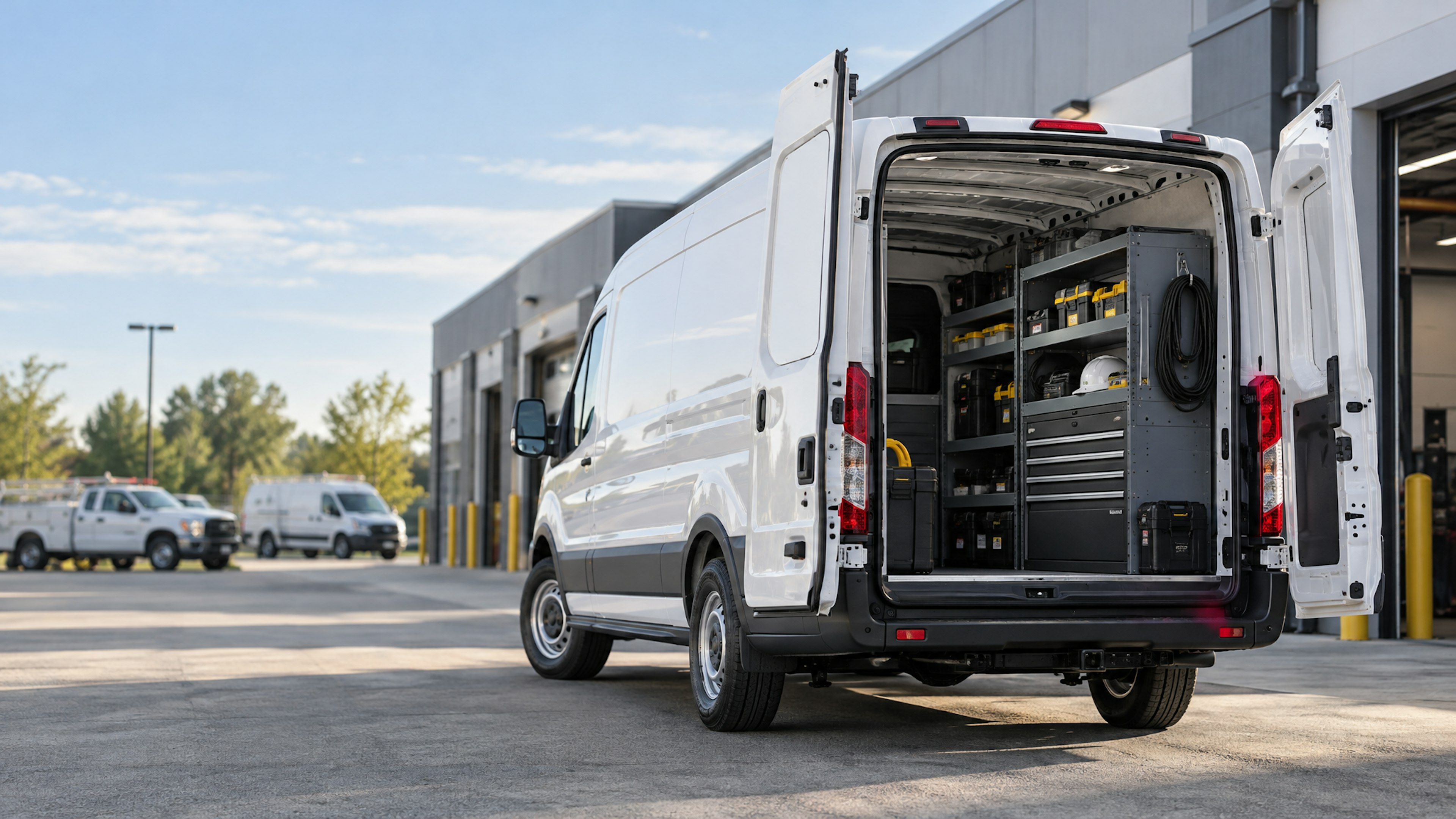
Unfortunately, Rubin notes, helper springs won't raise a truck's gross vehicle weight rating, and an overweight truck can draw a citation from a DOT officer. So fleets are stepping up to half- and three-quarter-ton pickups or moving into full-size vans, where Rubin is seeing much more interest and customization.
Consolidation in the truck accessory business most notably, RealTruck acquiring the LEER Group, has Rubin worried about higher prices and even longer lead times in 2027 for caps, a product that's already slow to arrive. Van shelving is a different story. "You have 10 different vendors eager to build you a custom package, and that competition will continue to keep cost under control," she says.
However, Rubin doesn't expect a stampede toward vans, since they cost more. She sees it as a cautionary tale. "Yes, some OEMs understand the value of fleet business and have spec’d out a very useful product since COVID," she says. "But is that the right product for the job that you need done?" Her advice is to spec for the actual weight each job requires, with enough standard specs to cover the range of work, instead of specing every vehicle for the heaviest job. (This article on how an upfitting playbook improves operations and reduces costs walks through that approach.)
Rubin also expects fleets to think harder about what happens to an upfit when the vehicle's done. "I know that people say, ‘Hey, I spent $10,000 on these van shelves, and I want some compensation,’ but the next guy might not need the same package you had, or it might not be in great shape. Then you’re just passing on removal costs, not a value-added vehicle component.” Unless auto auctions find a way to reward upfitted vehicles, she expects more fleets in 2027 to choose equipment that can move from one vehicle to the next, and more space in the market is becoming focused on these kinds of products, with attachment points that utilize OEM mounting points, modular systems that can be removed in one piece, and designs that are manufactured to last even in the case of heavy use.
Each vertical is unique unto itself.
Every vertical will have its own opportunities and challenges in 2027. To illustrate, Rubin describes some of what two verticals can expect in 2027.
Pest control: Rubin describes the industry as a self-feeding machine. "Somebody will start up a pest control business, build it up, sell it to one of the larger companies or to private equity, and then wait their required number of years before starting another one," she says. “Those companies have refined their builds so many times that pest control builds are becoming more common. Pest control outfits can get vehicles built to meet their needs all over the country; it’s no longer the same few upfitters and manufacturers dominating that space. In the end, this will lead to more specialized and customized builds for end users with lower prices and shorter lead times”
Pickups remain the ideal pest control vehicle because they keep chemicals separated from the driver. But smaller isn't always cheaper. "Some want to acquire something like a compact pickup; it’s more economical pricewise and easy to drive and park," Rubin says. "But those types of vehicles are designed to get one to the hardware store to pick up a couple of boards for your fence. It's not designed to carry a liquid tank, hose reels, and spray rigs. Sure, you can run tanks below capacity to stay under weight limits, but that caps how many homes a tech can treat in a day. You’ll also be hard-pressed to find upfits for it in the space, so while you might save on the chassis, you might end up paying more to make upfit components designed for a larger vehicle work instead.”
Disaster restoration and mitigation: The National Oceanic and Atmospheric Administration's Climate Prediction Center says a strong-to-very-strong El Niño is likely through early 2027, and Mike Albert's hometown got a preview this summer when flooding closed parts of I-71 in Cincinnati twice. Rubin knows a basement water mitigation specialist who had more work than he could handle.
“Disaster response has traditionally meant complex builds like command trailers,” says Rubin. “I expect the industry to start asking what it can get done out of a pickup or a van, and for more upfitters to offer those kinds of complex builds similar to how the prevalence of pest control builds has made those upfits more accessible.”
Lean hard on AI in 2027. Then lean harder on your peers.
Kraus sits on the AFLA education task force, which just launched a new learning module on applying AI from a fleet manager's point of view. He's an AI fan, within limits.
"What I've been taught is that AI gets you from 'I don't know anything' to average," he says. "It can't really take you from average to exceptional."
For that, he says, every fleet manager needs a personal board of directors built through groups like AFLA and the National Association of Fleet Administrators (NAFA). "They're not just going to coddle me and say, ‘That's awesome,’ because they like me," Kraus said. "They're going to say things like, ‘Have you tried this? Have you thought about that? I don't know that I would do that.’"
Planning for 2027? Talk to a Mike Albert fleet consultant about getting the most out of the year for your fleet and business.
About the experts
Jason Kraus, Vice President of Operations, has nearly 30 years of experience in automotive components and fleet management. At Mike Albert, he leads purchasing and pricing operations and manages strategic partnerships with original equipment manufacturers. He's a frequent industry speaker and serves on AFLA's education task force. Read Kraus's full bio.
Alexa Rubin, Truck Upfit Manager, has more than 11 years of experience in fleet management, supply chain optimization, and customer service. She designs upfit solutions around how fleets actually operate, and her team received a 2025 Van Upfit Package of the Year award. Read Rubin's full bio.
Sources: Wex Midyear Outlook, US Energy Information Association (EIA), Cox Automotive/Kelley Blue Book, AFLA, NAFA
Skills covered in the class
Operational Efficiency
Financial Management
Data-Driven Decision Making
Vehicle Life Cycle Analysis
Did you enjoy this class?
Share it with your organization and colleagues.
Similar Classes

Fleet Fundamentals
Fleet budget planning for 2027: Where costs are headed and how to keep them in check
October 26, 2026

Fleet Fundamentals
Impact Summary: U.S. Import Tariffs on Vehicles & Metals (2025)
February 12, 2025

Fleet Fundamentals
MY2026 and MY2027 Vehicle order bank updates for fleet buyers
September 9, 2026